

John Was Not A Footnote
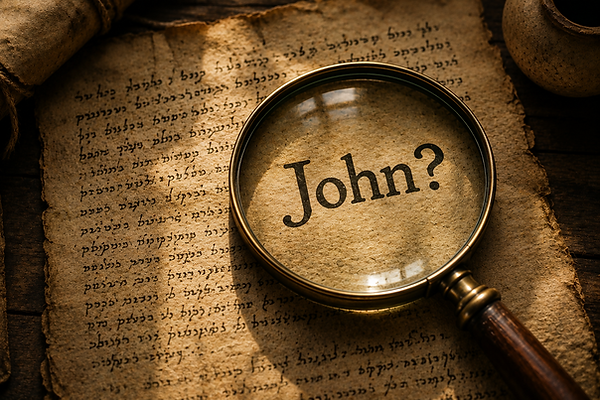
I’ve found myself thinking about John the Baptist lately.
If you’re familiar with the Christian story, you probably know a little about him. He’s remembered as the man who baptized Jesus and was eventually beheaded by Herod. Beyond that, though, he often fades quietly into the background, almost as though his only purpose was to introduce someone else.
The more I’ve sat with that, the stranger it feels.
So I started reading because I was curious. I wanted to know who John was before history gradually reduced him to a supporting role. I wandered into biblical scholarship, conversations about the Dead Sea Scrolls, the Essenes, the writings of Josephus, and even traditions that developed outside what eventually became orthodox Christianity. I’m certainly not an authority on any of it, but I’ve learned that when thoughtful people continue asking the same questions from different directions, they’re usually worth paying attention to.
The first thing I was reminded of was that John wasn’t living in a Christian world because Christianity didn’t exist yet. John was Jewish. Jesus was Jewish. The people listening to both of them were Jewish. Their conversations were taking place inside the world of Second Temple Judaism, not inside Christianity as we know it today.
That alone made me read John differently.
The next question that kept pulling at me was much simpler.
Why did John matter so much?
Not just to the people who walked for miles to hear him speak, but to someone like Herod. Whatever John was doing, it wasn’t being dismissed as the ramblings of a harmless man standing in a river. Crowds were gathering. People were listening. Something about him was compelling enough that those in authority paid attention.
Herod’s world was one where politics, religion, and power were woven tightly together. The Herodian rulers governed under Roman authority, the religious establishment held enormous influence, and those systems naturally reinforced one another. That doesn’t answer why John was considered dangerous, but it helps us understand the world he was standing in.
Then I realized something.
John didn’t invent immersion in water.
Jewish ritual washing already existed long before John stepped into the Jordan. Communities often associated with the Essenes—a Jewish movement remembered for communal living, simplicity, ritual immersion, and an inward preparation for a different way of living—were already using water as part of their spiritual practice. Water already carried deep symbolic meaning. So if the water wasn’t new, what exactly was John doing differently?
That’s the question I can’t seem to let go of.
We’ve inherited an interpretation that John’s baptism was about repentance and preparation, and that may very well be how the earliest followers understood it. But I keep coming back to the river itself.
Water has always fascinated me because of what it naturally does. It cleans. It carries. It reflects. It yields, yet over time it reshapes stone. Step into moving water and, even for a few moments, your experience changes. The world doesn’t stop, but you do. The noise softens. Your attention is redirected. You’re suddenly aware of your breathing, your heartbeat, your thoughts, and perhaps even your willingness—or unwillingness—to leave something behind.
The more I sit with that image, the more I wonder if John understood something profoundly human. Maybe the river wasn’t simply a symbol. Maybe it became a tangible way for people to cross an invisible threshold they had already reached within themselves. A line in the sand, so to speak. A moment they could feel. A moment they could remember. A moment that quietly said, From here forward, I’m willing to look at my life differently… to reconsider my relationship with the Divine, with myself, with the people around me, and perhaps even with the possibility that none of those things were ever as separate as I’d been led to believe.
That thought has stayed with me because it feels deeply human. We don’t always remember ideas, but we remember experiences. We remember the place where something became real. Maybe that’s why John stood in a river instead of a building. Maybe he understood that sometimes a physical experience becomes a lasting reminder—something we can return to years later whenever life begins pulling us back toward old assumptions. The river gave people something they could carry with them. Every time they remembered stepping across that invisible threshold, they could remember the decision that had already begun within them.
That’s where my own reading begins.
I don’t know if that’s exactly what John intended. What I do know is that every generation has interpreted him through its own lens. The gospel writers did. The early Church did. Scholars still do today. I’m simply adding another question to that long conversation.
One of the reasons I keep coming back to the Essenes isn’t because I need John to have belonged to them. We simply don’t know that. What interests me is that thoughtful scholars have continued asking the question for a very long time. They see enough similarities to keep wondering. Whether John lived among them or simply breathed the same cultural air, I don’t know. But I don’t think it’s an accident that those conversations continue.
Then there’s another thread that caught my attention. The Mandaeans, an ancient religious tradition that continues to honor John as one of their central teachers, preserve a very different memory of him than the one most of us inherited. Their tradition emphasizes living water, repeated baptism, and spiritual knowledge. I’m not bringing that up because I think it proves anything historically. It doesn’t. What it reminds me of is that history is almost never a single story. Different communities remembered different things.
The fact that John has remained so deeply revered in a living tradition for nearly two thousand years makes me pause. Whether that tradition preserves history, theology, or something in between isn’t really the point. It reminds me that not everyone remembered John as a footnote. Perhaps we’ve underestimated this remarkable human being. Perhaps there’s more to his story than many of us have been encouraged to notice.
The more I read, the more fascinating he becomes. I find myself wondering whether we’ve spent so much time talking about the man who came after John that we’ve quietly stopped listening to John himself.
Perhaps he wasn’t simply pointing people toward another teacher.
Perhaps he was inviting people to reconsider where authority truly begins, to rediscover their relationship with the Divine directly, and to recognize that transformation doesn’t always begin with someone standing above us. Sometimes it begins with a question, a decision, and the willingness to step into the river.

Accessibility
Audio is a spoken version of the article. Text is on this page.
© Original work by Rev. Tina M. Adkins