

The Cave is a Region of storage and containment within the InnerTerrain. It is an interior environment where experience is set down when engagement would overwhelm coherence. The Cave is not empty. It is quiet in its own way, deliberate, and formed through natural containment rather than imposed order.
Caves vary. No two InnerTerrain Caves look exactly the same. Some feel wide and open, with room to breathe and turn around. Some feel narrow or winding, with uneven footing and low ceilings that ask you to duck. Some hold only a few carefully placed items; others contain layers built up over time. These descriptions point to common features, not a required layout. Your Cave reflects how your experience organizes what it needs to hold.
Inside the Cave, space can feel surprisingly spacious once your eyes adjust. As vision settles, the interior often reveals itself as unexpectedly beautiful—stone shaped over time into arches, columns, and sweeping curves, surfaces catching light in quiet, breathtaking ways. Sound behaves differently here—muted, close, sometimes echoing faintly off stone when you move. The air often feels cooler and denser, with a mineral stillness you can almost taste. Light may be dim or indirect, catching on edges and surfaces rather than flooding the space, enough to orient without demanding attention. The body often draws inward here: shoulders rounding slightly, breath dropping lower into the ribs or belly, weight settling downward through the feet, attention turning toward what is already being carried rather than what is approaching.
Being in the Cave is a physical experience. The floor feels uneven underfoot, cool stone pressing through the soles, steady and unmoving. The air holds weight without heaviness, damp enough to notice on the skin, carrying the faint scent of earth, mineral, and time. Small sounds register clearly—the shift of your breath, fabric brushing an arm, a footstep echoing once before disappearing. Nothing rushes you here. The Cave responds slowly, if at all, and that slowness lets your nervous system settle into its own rhythm without needing to perform or explain.
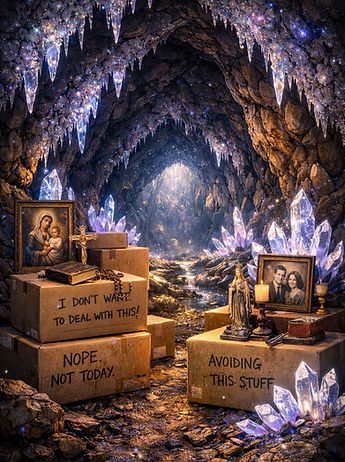
The Cave organizes itself through natural formations of containment. Boxes may be stacked, tucked into alcoves, or set where they fit. Their surfaces might be worn, dusty, smooth from handling, or rough at the edges. Labels tend to be plain and direct—not as confessions, but as timing markers: Nope. Not today. Not dealing with this. Don’t want to remember it. Too much. Later. These are not instructions and not promises. They are records of pacing. The InnerTerrain does not judge them.
What is stored in the Cave is often familiar. Objects of meaning, unfinished material, deferred conversations, unresolved moments, versions of identity that once mattered. You may recognize the weight of them before you recognize their content. Nothing here is broken. Nothing is condemned. The Cave preserves integrity by holding experience at rest, without pressure to resolve or transform it.
Crystalline formations may appear along the walls—not as decoration, but as stabilizing structures. They hold shape and define the space. They catch and reflect low light, buffering what’s inside from disturbance. They help the Cave feel protected and insulated, a place where what is stored cannot be intruded upon or disturbed before its time. The Cave does not push clarity. It does not demand engagement. It allows what is held to remain intact, without turning it into something that must be processed.
A path is often visible within the Cave, though its distance and clarity can vary. Some paths feel close enough to step onto. Others feel far off, barely lit, or partially obscured. This variation matters. The Cave is not sealed, but access is never forced. Deferred does not mean lost—and it also does not mean required. You can set something down and never pick it up again if that’s what coherence calls for.
Being near what is stored can sometimes feel agitative. There may be a low hum of anxiety, a sense of pressure, or the feeling that something ought to be dealt with. That sensation doesn’t come from the Cave itself. It comes from proximity combined with habit. The Cave allows you to notice that pressure without obeying it.
The Cave exists because experience accumulates. It is part of the InnerTerrain so nothing has to be carried all at once.
© Original work by Rev. Tina M. Adkins
The Cave

Accessibility
Audio is a spoken version of the article. Text is on this page.